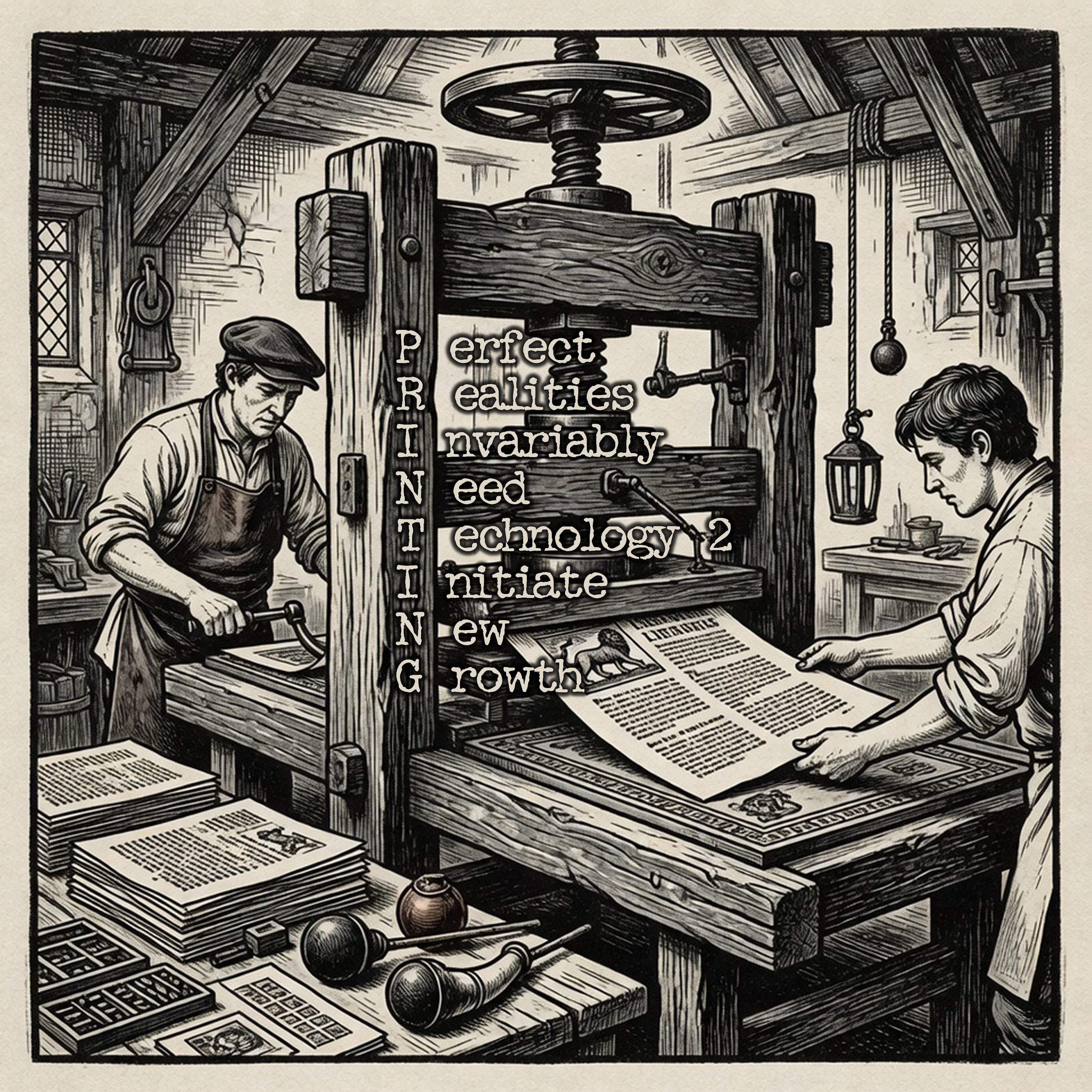
Printing is an important part of society, even in a world were people are no longer only have to depend on books. Of course its first appearance was ages ago, when knowledge was mostly confined to those people who could afford to buy books that had been manually copied by scribes and monks. The invention of the printing press made mass printing possible, but it was still a process that required a lot of manual labour: printers would only print one or two pages at a time, and you could print multiple copies, but binding them together would also take a lot of manual sorting and sewing to make sure the pages ended up in the right order. Pages to print would first be composed from individual metal letters that were kept in a wooden case with numerous divisions. Its main division split between capitals and normal letters, and capitals were in the upper case. That is how uppercase and lowercase got their meaning.
Still though, the process made information available to more common folk, which was definitely a useful function. Once computers came into being, printers swiftly followed, and I remember having seen one during a tour of an IBM computer center in the Netherlands. Back then printers were bulky beasts, resembling a somewhat scaled down version of the newspaper printing machines. But personal printing was still hard to come by back then.
Of course that changed over time, and printers are now quite common and even already outdated since a paperless world is being pushed so we don't kill too many trees. But printing is by no means an outdated process. Nowadays it has moved from twodimensional to threedimensional processes, and currently my 3D printer is making stuff out of plastic, while sitting next to my all-in-one 2D printer which is mainly used for digitizing printed paper.
And the evolution is not yet over. 3D printing now moves towards more materials (even simultaneously), and research even moves towards smaller and smaller dimensions, which will likely continue until we can master what nature has been doing since before human beings were alive: print structures atom by atom, which will likely involve moving atoms by sound or something similar.
BACK  HOME