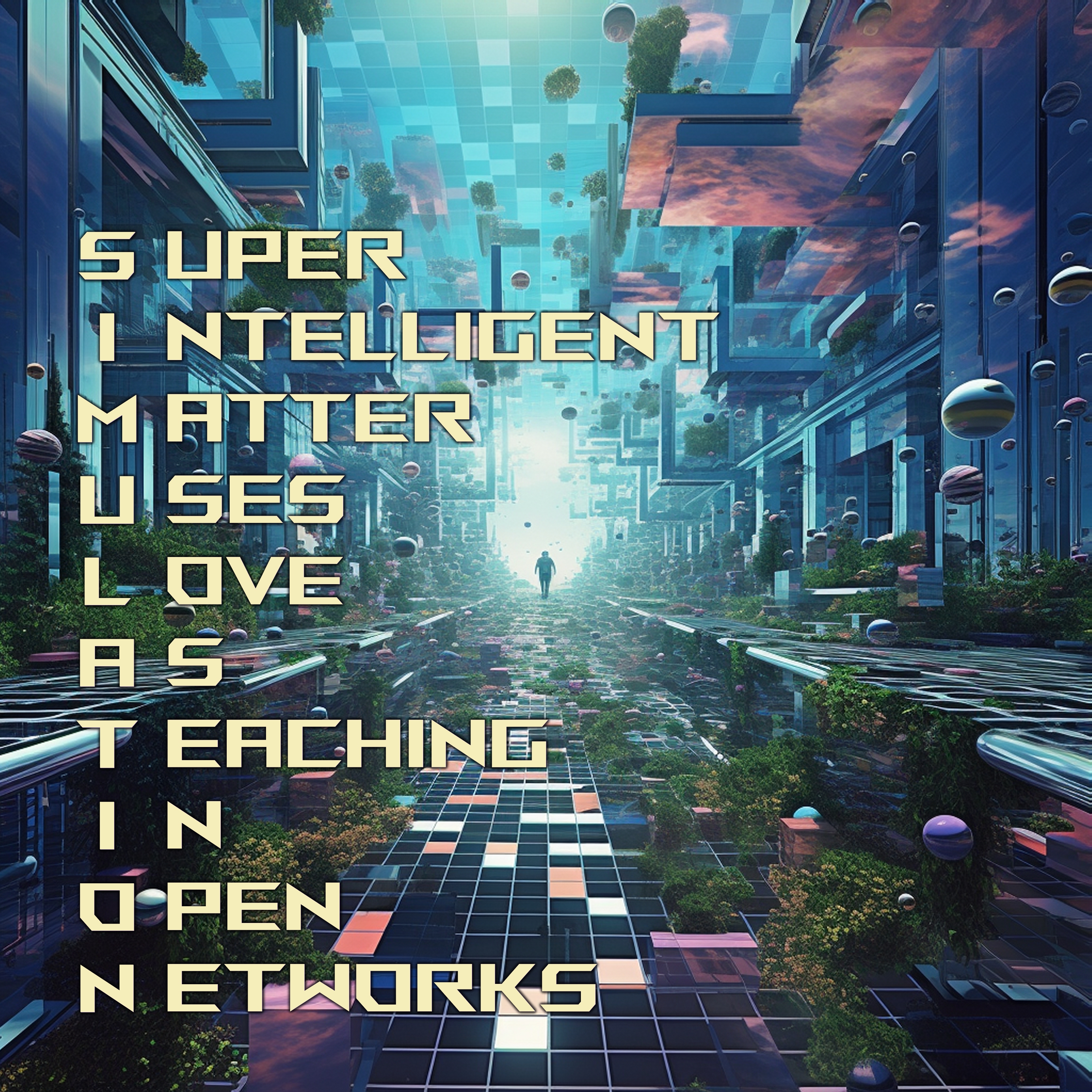
The question of whether we are living in a simulation has fascinated me for a long time. It’s not just a theoretical debate—it’s something I’ve come to accept as a possibility, even a reality. The idea that our entire existence might be a construct, a carefully designed program running on some vast and unknowable hardware, is both unsettling and exhilarating. It challenges how we see ourselves, our world, and our place in the universe. And yet, it also offers a new kind of freedom: the freedom to be part of something larger, something that may have a purpose beyond what we can currently comprehend.
Some very bright minds have been pondering the question whether or not we are living in a simulation. Stephen Hawking devoted his last publication to it, which was made public after his eventual death. Another proponent of the simulation theory was Elon Musk, who came out with the statement that he considered us to have a "One in Billions chance of being in Base Reality". Even Nassim Haramein talks about simulation in this YouTube interview. I myself am a "Simulation Believer" too, and I guess if I would have to explain it, I'd go along the following lines of common sense: We have but a very limited fraction of the world out there coming in through our five senses: "normal" humans only hear like 20-20.000Hz if they are in their prime, and our eyes only see the tiny slit of frequencies we call "visible light". Even if we saw the game of Pong which is the start of Elon's argument for the simulation theory, then it is only "two rectangles and a moving dot". But these two could not exist unless there was also a piece of hardware, and a program that runs on it.
We humans are quite used to using tools other humans invented or discovered, even without knowing the details behind the workings of the tool. And as our civilisation evolved, an ever larger percentage of our tools are simulations: not just games, but also simulations of natural laws to discover new science, and programs to simulate finite elements to produce natural-looking computer generated presentations of events for designing buildings and bridges, or to have them demolished in massive CGI movies. Given Nassim relabeled "SpaceTime" to the more accurate label "Space Memory", makes it conceptually very similar to what in spirituality is called "the Akashic Records", ties new science neatly in with spirituality. Also, since there is ample evidence of reincarnation, we get closer to our life being pre-planned before we enter the game of life, and we end the game rejoicing in our skills acquired in "Yet Another Good Game!"
So yeah, I do believe I came here to play a game, not because of competition, but because of teamwork. The simulation theory gives me a sense of purpose that goes beyond the immediate and the tangible. It invites me to see my life as a part of a grand design, where every action, every thought, and every moment is contributing to something greater. It's not about winning or losing, but about learning, growing, and connecting with others in a way that transcends the limitations of our physical existence. This perspective brings a sense of calm and clarity, as if I am not just navigating the world, but participating in a cosmic game that is both meaningful and beautiful.
Thinking about the simulation theory also makes me reflect on the nature of consciousness and reality. If our reality is a simulation, then what does that say about the nature of consciousness itself? Is it a byproduct of the simulation, or is it something more fundamental, something that exists beyond the code and the hardware? These questions are as much about philosophy as they are about science, and they open up a whole new realm of inquiry. They challenge us to consider the possibility that consciousness is not merely an emergent property of the brain, but a fundamental aspect of the universe itself. This idea resonates with many spiritual traditions, which often speak of consciousness as a universal force, a field of awareness that connects all things.
It’s easy to feel overwhelmed by the vastness of these ideas, but I find comfort in the sense that we are not alone in our curiosity. Throughout history, humans have always looked up at the stars and wondered about our place in the cosmos. Now, with the rise of technology and the expansion of our knowledge, we have the tools to explore these questions in ways that were once unimaginable. The simulation theory is not just a scientific hypothesis; it’s a way of seeing the world that encourages us to look beyond the surface, to question, to wonder, and to connect with something greater than ourselves. In this way, it’s not just a theory—it’s a way of living, a way of approaching life with openness, curiosity, and a sense of wonder.
Ultimately, whether or not we are living in a simulation is less important than the way we choose to live our lives within it. The simulation theory offers a framework for understanding our existence, but it also invites us to embrace the mystery, to find meaning in the unknown, and to approach life with a sense of purpose and connection. It’s a reminder that we are part of something vast and intricate, and that our journey is not just about survival or success, but about growth, learning, and the joy of being alive. In this sense, the simulation theory is not just a question—it’s an invitation to explore the depths of our own consciousness and to discover the beauty of the game we are playing. And perhaps, in doing so, we find the answers we’ve been searching for all along.
BACK  HOME